
Perforated vs Ladder Cable Trays for Solar Installations
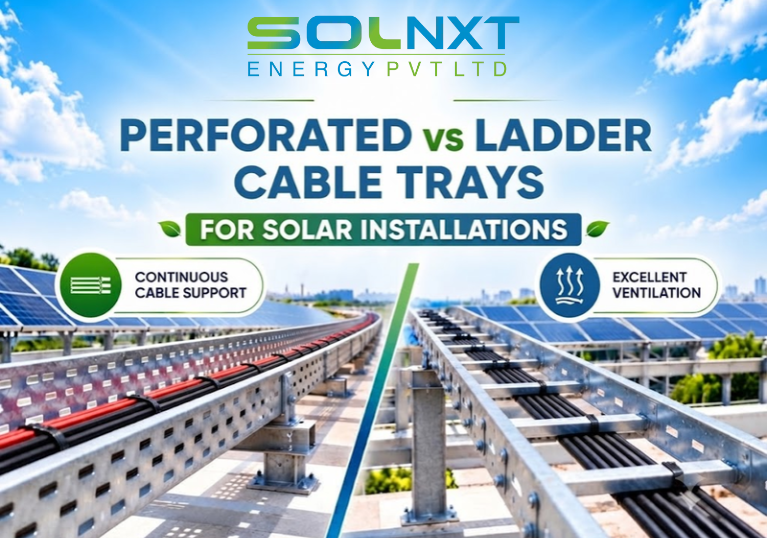
Cable management is an essential part of solar power installations. Proper cable routing helps maintain an organized electrical system, supports inspection and maintenance and protects cables when the system is designed and installed correctly.
Choosing between perforated and ladder cable trays depends on the type of solar installation, cable load, ventilation requirements, environmental conditions and installation costs. Both cable tray types have specific advantages for rooftop solar systems, commercial installations and large-scale solar power plants.
In this guide, we compare perforated vs ladder cable trays for solar installations to help solar EPC contractors, electrical engineers and project developers select a suitable cable management solution.
What Is a Perforated Cable Tray?
A perforated cable tray is manufactured from a metal sheet with regularly spaced holes or slots across its base and sides. It provides continuous support beneath cables while allowing some airflow through the openings.
Benefits of Perforated Cable Trays :
Continuous cable support: The tray base supports cables along the cable route.
Ventilation: Perforations allow airflow around the cables.
Organized cable routing: Helps arrange solar DC cables and other electrical wiring neatly.
Flexible installation: Suitable for different cable routing layouts with appropriate fittings.
Maintenance access: The open top and perforations can help with cable inspection and fastening.
What Is a Ladder Cable Tray?
A ladder cable tray consists of two parallel side rails connected by evenly spaced crossbars called rungs. Its open construction provides excellent ventilation and allows cables to be secured at suitable intervals.
Ladder cable trays are frequently used in industrial electrical installations, utility-scale solar plants and projects involving long cable routes or substantial cable bundles.
Benefits of Ladder Cable Trays
Excellent ventilation: The open structure promotes airflow around cables.
Suitable for longer spans: Properly engineered ladder trays can accommodate longer support spans, depending on their load ratings.
Easy cable inspection: The open design provides convenient access to cables.
Flexible cable fastening: Cables can be secured to the rungs using suitable cable ties or clamps.
Industrial applications: Useful for large-scale solar plants and electrical infrastructure.
Perforated vs Ladder Cable Trays: Key Differences
Personal interactions were an important part of our participation at REI Expo 2026. Our team met visitors from across the renewable energy ecosystem, including professionals interested in solar mounting products and project applications.
These conversations helped us understand customer expectations, discuss specific requirements and explore potential areas of collaboration.
| Feature | Perforated Cable Tray | Ladder Cable Tray |
|---|---|---|
| Construction | Metal base with holes or slots | Side rails connected by rungs |
| Cable Support | Continuous base support | Support at regular intervals |
| Ventilation | Good, depending on design | Generally excellent |
| Typical Applications | Rooftop and commercial installations | Large solar plants and industrial routes |
| Cable Fastening | Various positions along the tray | Commonly secured to rungs |
| Inspection | Accessible through the open top and perforations | Convenient access through the open structure |
| Long-Span Suitability | Depends on design and load rating | Often suitable for engineered long-span installations |
| Selection Priority | Continuous support and routing flexibility | Ventilation and accessible cable routing |
Which Cable Tray Is Best for Solar Installations?
Perforated Cable Trays for Rooftop Solar Systems
Perforated cable trays may be suitable for residential, commercial and industrial rooftop solar installations where cables need continuous support along designated pathways.
They can help organize wiring between solar panels, inverters and other electrical equipment. The tray material and finish should be selected according to roof conditions and exposure to moisture, sunlight and corrosive environments.
Ladder Cable Trays for Large Solar Power Plants
Ladder cable trays are often suitable for utility-scale solar installations with long cable routes, large cable bundles and high ventilation requirements.
Their open structure supports convenient inspection and cable access. However, engineers must check the required load capacity, support span, cable arrangement and applicable project specifications before selecting a ladder tray.
Consider Cable Load and Size
Ladder cable trays are often suitable for utility-scale solar installations with long cable routes, large cable bundles and high ventilation requirements.
Their open structure supports convenient inspection and cable access. However, engineers must check the required load capacity, support span, cable arrangement and applicable project specifications before selecting a ladder tray.
Evaluate Environmental Conditions
Solar cable trays may be exposed to rain, humidity, dust, sunlight, and temperature fluctuations. Choosing an appropriate material and corrosion-protection finish is essential for outdoor applications.
Depending on project conditions, options may include hot-dip galvanized steel, pre-galvanized steel or aluminium. The selection should account for corrosion exposure, mechanical strength and project specifications.
Compare Installation and Maintenance Costs
The total cost of a cable tray system includes more than the tray itself. Consider supports, fittings, connectors, fasteners, labour, maintenance access and future expansion requirements.
Perforated and ladder cable trays may have different installation costs depending on the project layout. Comparing the complete installed system provides a more meaningful cost assessment.
Why Is Proper Cable Management Important in Solar Projects?
Solar installations contain electrical cables that connect modules, inverters, combiner boxes and other system components. Poor cable routing can create maintenance difficulties, increase the risk of mechanical damage, and complicate inspections.
A properly selected and installed cable tray system helps keep cables organized, supports inspection and makes future maintenance more manageable. Tray selection should also consider electrical separation requirements, UV exposure, grounding and bonding and the manufacturer’s installation guidance.
At SOLNXT Energy, solar mounting structures and related installation components support the infrastructure required for solar projects. Explore our Solar mounting accessories and SOLNXT Energy website to learn more about our product range.
Conclusion
Choosing between perforated vs ladder cable trays for solar installations requires evaluating cable support, ventilation, load capacity, environmental exposure and maintenance requirements.
Perforated cable trays can be suitable for installations requiring continuous cable support, while ladder cable trays are often preferred for applications where ventilation and accessible cable routing are priorities. Both options can perform effectively when properly specified, installed and maintained.
Solar EPC contractors, electrical engineers and project developers should assess their project requirements before making a final selection. Choosing the right cable tray helps establish a well-organized and maintainable electrical infrastructure for solar power systems.
Frequently Asked Questions (FAQs)
1. What is the difference between perforated and ladder cable trays?
Perforated cable trays feature a metal base with holes or slots, while ladder cable trays consist of two side rails connected by crossbars. Their cable support and ventilation characteristics differ.
2. Which cable tray is better for solar installations?
The best choice depends on the project. Perforated trays offer continuous cable support, while ladder trays generally provide greater ventilation and convenient access for larger cable routes.
3. Are perforated cable trays suitable for rooftop solar systems?
Yes. They can be suitable for rooftop solar installations when their load capacity, material, corrosion protection and support arrangement meet project requirements.
4. Why are ladder cable trays used in solar power plants?
Ladder cable trays are commonly considered for large solar plants because their open design provides good ventilation, cable access and flexibility for longer cable routes.
5. How do I choose the right cable tray size for a solar project?
Consider cable quantity, cable diameter, total load, tray width, support spacing, future expansion and applicable project specifications before choosing a cable tray.